The Work Behind a Garden in Bloom
Flowers may look effortless when the whole shrub is in bloom. The photographs tell the fuller story: attentive hands, careful cuts, regular water and the patience to return throughout the season.
Beauty begins with close attention
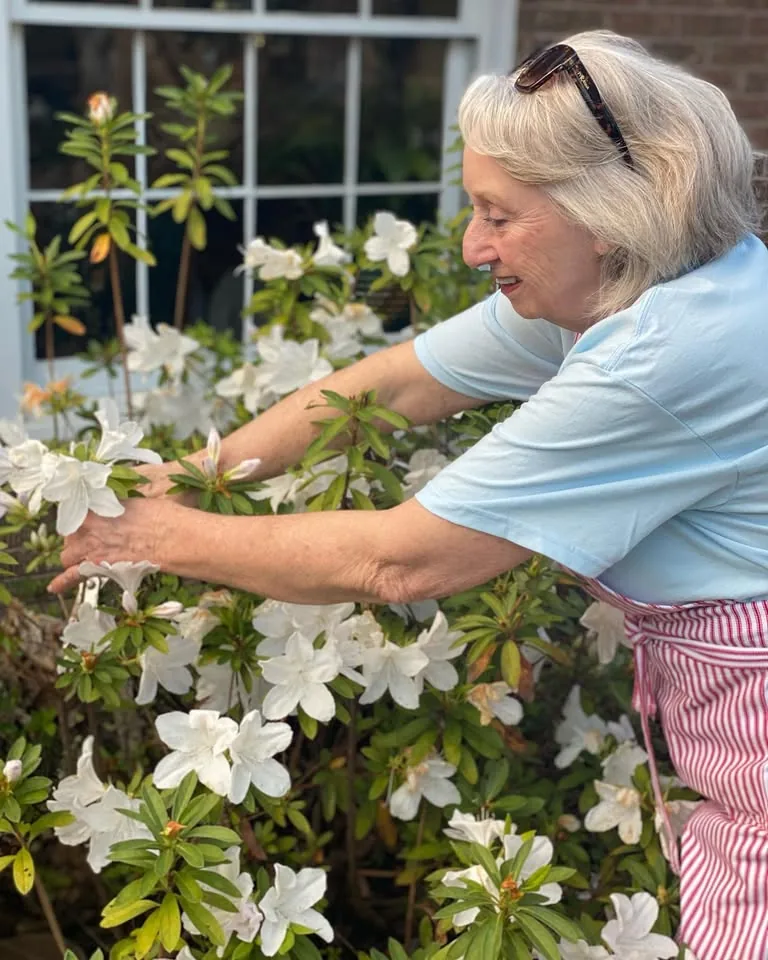
The opening photograph places Brenda almost inside a large shrub covered with white flowers. Wearing a pale blue shirt and striped apron, she reaches between the branches with both hands. Sunglasses rest on her head, and her expression shows the easy concentration of someone doing familiar work.
From a distance, a flowering shrub can look like one continuous cloud of color. Up close, the gardener sees individual conditions. Some blooms are fresh, others are fading, and certain branches may be crossing, crowding or growing in an unhelpful direction. The work begins by slowing down enough to see those differences.
This kind of inspection rarely produces a dramatic before-and-after picture. Its value is cumulative. A stem guided today, a damaged branch removed tomorrow and soil checked after a dry spell all contribute to the display that visitors later experience as effortless beauty.
The garden sets its own schedule
Household work can often be postponed until a more convenient hour. Plants are less interested in our calendars. Heat determines when watering is useful. New growth changes the best time to prune. A bloom that is ready today may be scattered by wind tomorrow.
A dependable garden routine therefore combines planning with responsiveness. The gardener may begin with a list, then change it after noticing dry soil, insect damage or a plant leaning under its own weight. Observation is not separate from the work; it decides which work matters.
Seasonal awareness also prevents unnecessary effort. Not every shrub should be cut at the same time, and not every yellow leaf signals the same problem. Good care is specific. When the plant variety or condition is uncertain, careful research is more useful than aggressive action.
A careful cut serves more than one purpose
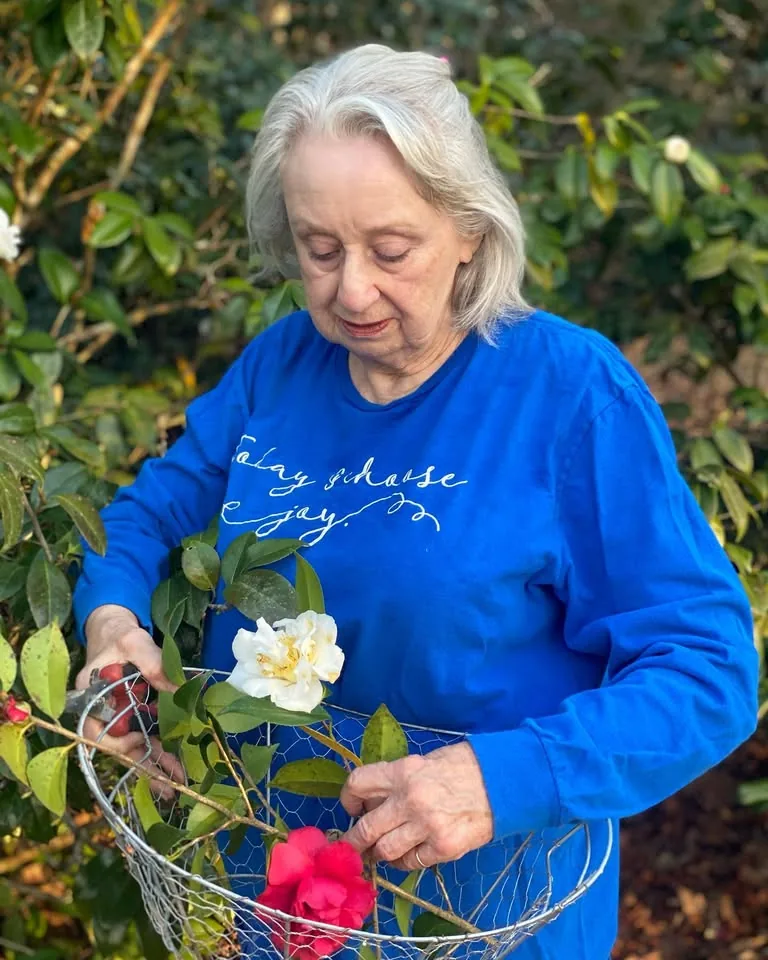
The second photograph moves closer to the task. Brenda holds red-handled pruners near a branch while guiding red and white flowers into a wire basket. Her attention is on the stems rather than the camera. The image shows gardening as a sequence of small decisions performed by hand.
A clean cut can remove damaged growth, improve shape or gather flowers for use indoors. Where and when that cut is made matters. Cutting blindly can sacrifice next season’s buds or leave a torn stem vulnerable. The safest approach is to identify the plant and understand its flowering habit before doing extensive pruning.
Tools matter as well. Sharp pruners require less force and produce a cleaner result. They should be kept dry, maintained and cleaned when moving between plants if disease is a concern. A simple hand tool becomes trustworthy through the same repeated care the garden receives.
The basket limits the work in a useful way
The wire basket appears throughout the sequence as both container and measure. It is large enough for a modest group of cuttings but small enough to carry comfortably across the yard. Its open sides allow leaves and flowers to remain visible instead of being crushed into a deep bucket.
A limited basket encourages restraint. The purpose is not to remove every beautiful bloom. A few stems can brighten the house while leaving plenty of color outdoors for the plant, pollinators and people passing through the yard.
Restraint is part of stewardship. A garden gives generously when it is not treated as an unlimited supply. The gardener takes what is useful, protects future growth and remembers that today’s appearance is only one moment in a longer seasonal cycle.
Water belongs at the roots
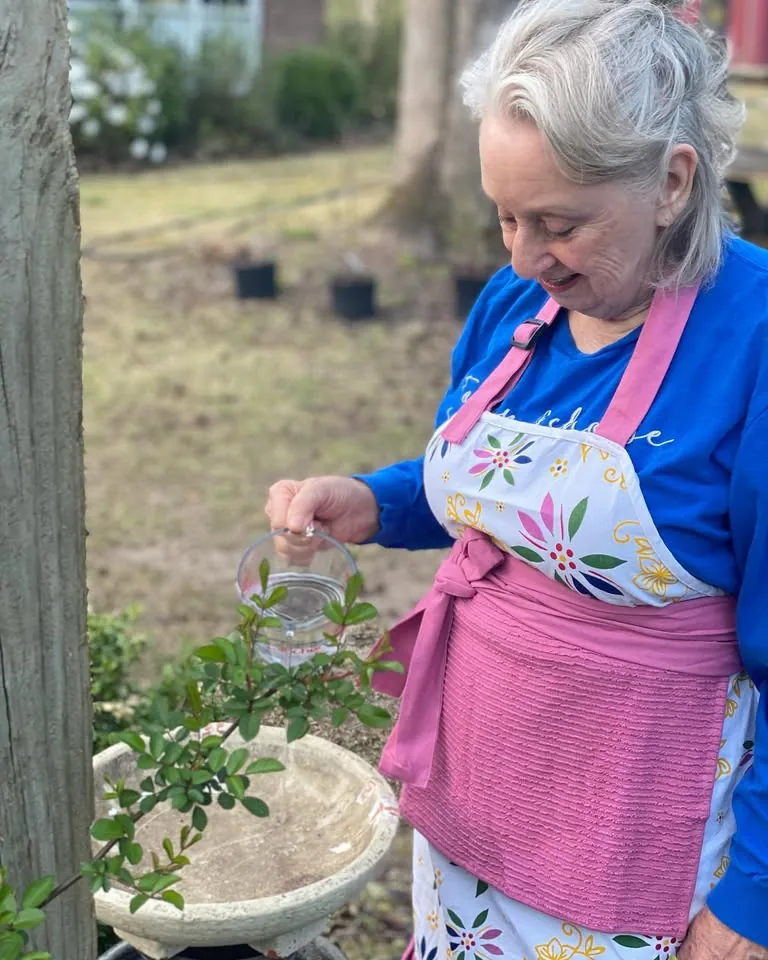
The third photograph shows a different kind of care. Brenda stands beside a large container and tips water toward a small leafy plant. Her flowered apron includes a thick pink front panel, practical protection for work that can splash soil and water onto clothing.
Watering looks simple, yet thoughtful watering depends on observation. Container plants can dry more quickly than those growing in the ground, especially in warm or windy weather. The surface may appear dry while moisture remains below, so checking the soil helps prevent both neglect and excess.
Directing water toward the root area makes the task efficient. A slower application gives soil time to absorb moisture rather than letting it run away. The correct amount varies with container size, drainage, weather and plant type; a fixed schedule cannot replace checking what the plant actually needs.
Maintenance is the real garden story
Photographs often celebrate the peak moment: a shrub covered in flowers, a basket filled or a vase arranged on the table. The daily maintenance behind that moment is less glamorous and more important. Weeding, watering, cleaning tools and watching for change rarely receive their own portrait.
That is why this sequence feels useful. It does not jump directly from untouched plant to finished arrangement. We see Brenda reaching, cutting and watering. The body is part of the work—hands steady a branch, eyes follow the blade and weight shifts to reach the correct spot.
Regular maintenance also protects the gardener. Smaller tasks completed often are easier on the body than one exhausting attempt to fix everything at once. Cool hours, supportive shoes, gloves when appropriate and short breaks help preserve the pleasure of returning.
The final still life tells the truth
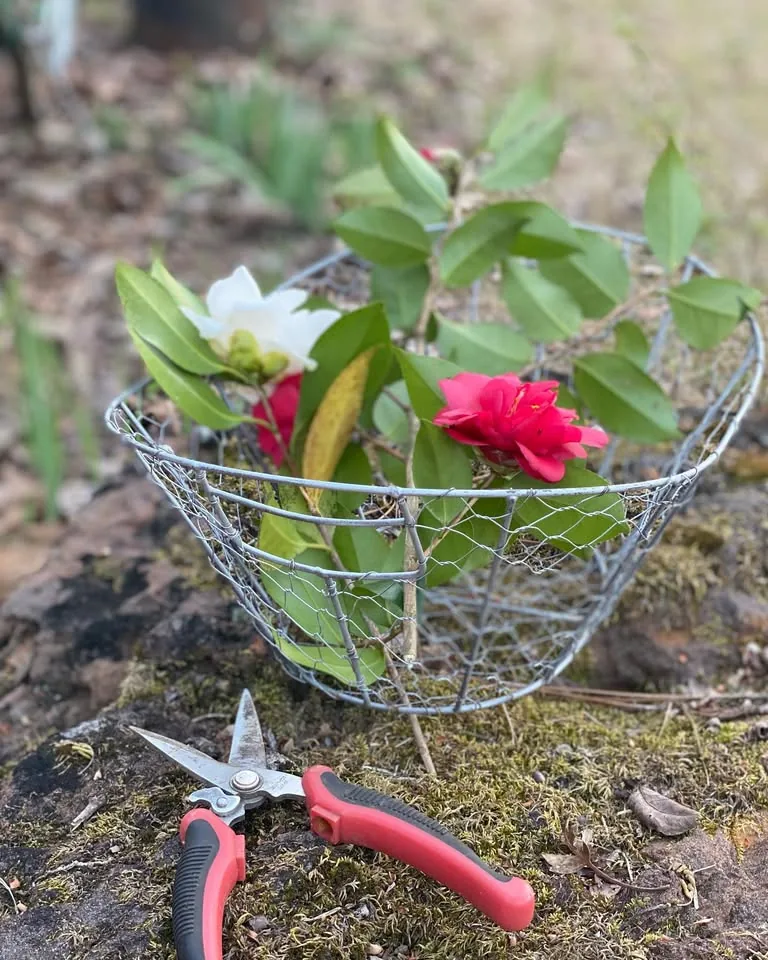
In the last image, no person appears. The wire basket sits on a mossy surface holding leafy branches and red and white blooms. The red-handled pruners lie open in the foreground. Soil, fallen leaves and an unpolished garden background remain visible.
This is not a produce harvest, and describing it that way would weaken the story. It is a gathering of flowers and cuttings—the visible result of tending ornamental plants. Accuracy makes the image more interesting because readers can appreciate the actual task rather than search for vegetables that are not there.
The open pruners give the still life a sense of recent action. Someone has just set them down, perhaps to carry the basket or inspect another branch. The arrangement is not overly styled; it looks like work paused rather than work performed for display.
From the yard to the rooms inside
Cut flowers create a gentle bridge between garden and home. They may be placed near the kitchen sink, at the center of a table or in a small vase where somebody will notice them during an ordinary task. Their short indoor life encourages attention to the present season.
Garden material should be checked before coming inside. Damaged leaves can be removed, stems recut as appropriate and containers cleaned. Thoughtful preparation helps the display last while keeping insects and debris from traveling farther than intended.
The arrangement need not be elaborate. A few branches often retain more of the garden’s character than a rigid composition. Different stem lengths, leaves and partially opened buds allow the plant’s natural growth to remain visible.
Garden work and kitchen work share a rhythm
The connection between garden and kitchen is not limited to edible plants. Both spaces teach care through repetition. Tools are cleaned because they will be needed again. Ingredients and flowers are used while fresh. Waste becomes compost where appropriate, returning organic material to the soil.
Both spaces also reward attention over speed. Dough responds to touch; soil responds to moisture. A cook and a gardener learn to notice small signals that a written schedule cannot fully capture. Experience becomes a conversation with changing material.
The bloom is the visible chapter, not the whole book
The white-covered shrub in the opening photograph is the garden’s public achievement. The remaining images reveal what supports it: selective cutting, measured water, useful tools and a basket that carries part of the season indoors.
A garden in bloom is never truly finished. Flowers fade, branches extend and weather rearranges the work. That ongoing demand is not a flaw. It creates a reason to return, observe and participate in change.
These four photographs make the invisible effort visible. Beauty is present in every frame, but so are concentration, dirt, tools and practical judgment. The flowers are lovely precisely because somebody was willing to do the work behind them.