Love, Partnership and a Long Family Story
A shared life is rarely preserved in one perfect portrait. It appears across decades—in a formal embrace, a laugh beside the kitchen table and the easy affection of two people completely at home with one another.
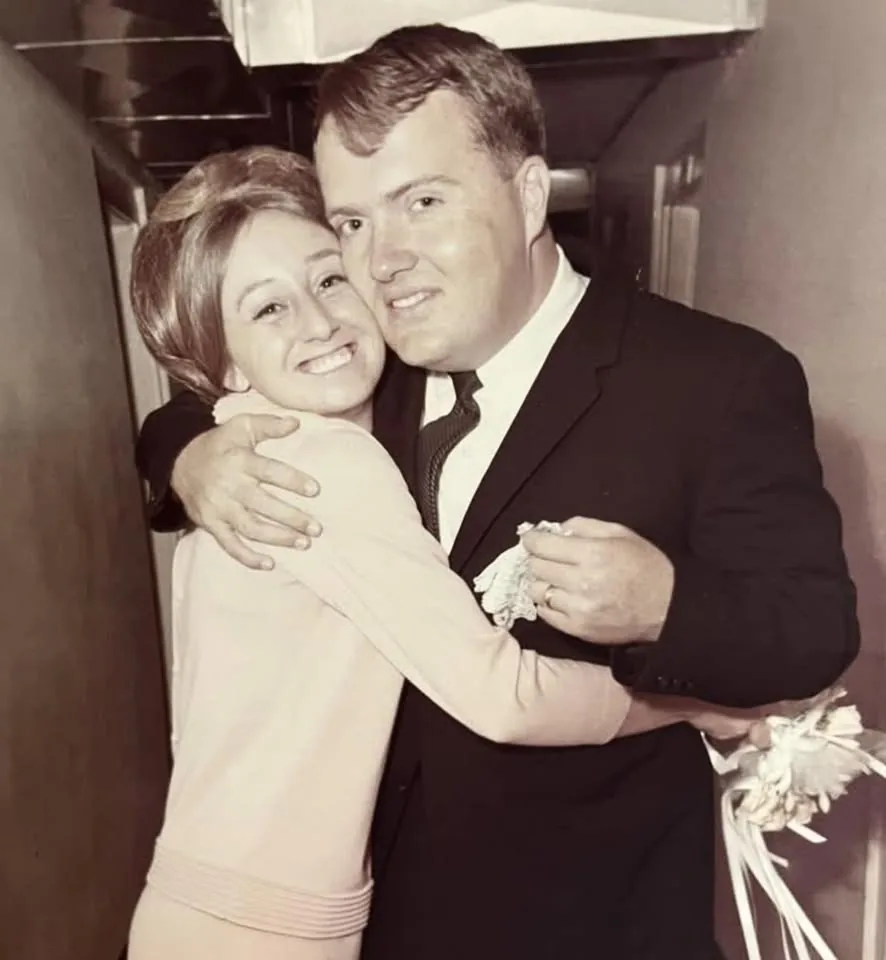
A beginning held in black and white
The opening photograph feels wonderfully immediate despite its age. A young couple stands in a narrow indoor space, dressed for a formal occasion. He wears a dark suit and tie; she turns toward him in a light dress, smiling broadly as his arm circles her shoulders. Small flowers and ribbons appear near their hands, adding a note of celebration without revealing more than the image can honestly tell us.
Old photographs often carry a seriousness imposed by time, but this one resists it. The pose is close and affectionate rather than stiff. Their expressions suggest that the camera interrupted a happy moment instead of creating one. Even the tight hallway adds charm: there is no grand backdrop, only two people filling an ordinary space with the energy of a special day.
We cannot see everything that came before or after the shutter clicked. That limitation is part of the photograph’s power. It preserves a beginning without explaining the future. The years ahead—homes, work, family routines, meals and decisions—remain invisible, waiting beyond the edge of the frame.
Partnership is built in ordinary rooms
Romantic photographs celebrate feeling, but a long partnership is sustained by practice. It grows through repeated mornings, shared responsibilities and the thousand adjustments required when two lives move forward together. One person remembers an appointment; the other notices the groceries running low. Plans change, children grow, work becomes demanding and the household keeps asking for attention.
The kitchen naturally becomes part of that story. It is where days begin, news is exchanged and practical care takes visible form. Cooking for another person may look like an everyday task, yet repetition gives it meaning. A familiar breakfast says, “I know what helps you start the day.” A plate kept warm says, “I expected you home.” A favorite dessert appearing without announcement says, “I remembered.”
Not every act of love is dramatic enough for a photograph. Most are small enough to disappear into routine. Together, however, they create the dependable structure in which a family can grow.


The kitchen photograph tells a larger story
In the second image, many years appear to have passed. Brenda sits beside an older man at a wooden table while he kisses her cheek. She is laughing directly toward the camera, one hand resting against his chest. He wears a jacket over a white shirt; she wears a black dress and a gold pendant. They may be dressed for an occasion, but the setting remains warmly domestic.
The wood-paneled kitchen is more than background. A sink, counter, dishes and framed family photographs surround the couple. These are signs of a room shaped by use. The picture allows affection and household life to occupy the same space, which is exactly where a long partnership often finds its deepest expression.
There is fruit on the counter and seating close by. We can imagine that people gathered before the photograph and continued talking afterward, though we do not need to invent the event. What the image clearly offers is a moment of delight in a familiar room. The couple has not stepped away from daily life to demonstrate affection; affection has appeared inside daily life.
Keeping playfulness in the picture
The final photograph is less polished and more playful. The couple shares a kiss while wearing casual clothes, and the close crop leaves little space for anything else. Unlike the careful formality of the first image, this one feels spontaneous—something captured because the people nearby recognized a moment worth keeping.
Playfulness is easy to underestimate when telling a long family story. We often emphasize duty, endurance and sacrifice, all of which matter. But humor and affection also do practical work. They release pressure, help people forgive small annoyances and restore a sense that the relationship contains more than a list of responsibilities.
A family archive becomes more honest when it includes this texture. The composed portrait shows how people wished to mark an important day. The candid kiss shows how they could still surprise one another. Both belong to the same story.
Meals become landmarks in a shared life
Years are difficult to remember as continuous stretches, so families often organize memory around gatherings and food. There was the holiday when everyone squeezed around one table, the summer supper eaten outdoors, the birthday cake that leaned slightly and the quiet meal made after a hard week. Recipes become landmarks because they return while everything else is changing.
In a partnership, familiar dishes create a private shorthand. One meal belongs to celebration, another to comfort and another to the night when nobody has much energy. The recipe need not be complicated. Its meaning comes from who made it, who waited for it and how many times the table welcomed both people back.
This is also how food traditions become family traditions. A dish prepared for two is eventually served to children, grandchildren, friends and neighbors. What began as care between partners widens into hospitality for a whole community.
The unseen work of growing together
A sequence of photographs can show age, clothing and changing surroundings, but it cannot show the full labor of a shared life. It misses the negotiations, the repaired misunderstandings, the courage required during loss and the ordinary loyalty of continuing to help. Those things are too gradual for a camera.
Still, expressions can hint at what has accumulated. The early embrace has excitement and promise. The later kitchen photograph carries ease. The casual kiss adds humor. Read together, the images suggest that companionship is not a single feeling preserved unchanged; it is a relationship repeatedly renewed in new circumstances.
What a long family story leaves behind
The greatest legacy of partnership may be the atmosphere it creates for others. A home shaped by steady affection becomes a place where family members feel safe arriving, eating and telling the truth about their lives. Children learn that care can be practical. Guests notice that laughter is welcome. Recipes, habits and stories are passed onward because there is a table around which to share them.
These photographs do not need invented dates or elaborate captions to move us. Their sequence is enough: youth beside youth, affection in a well-used kitchen, and playfulness surviving into a later season. The surroundings change, but the instinct to move closer for the photograph remains.
A long family story is made of precisely such continuity. Love begins as possibility, becomes daily work and, when tended carefully, returns again as laughter.